
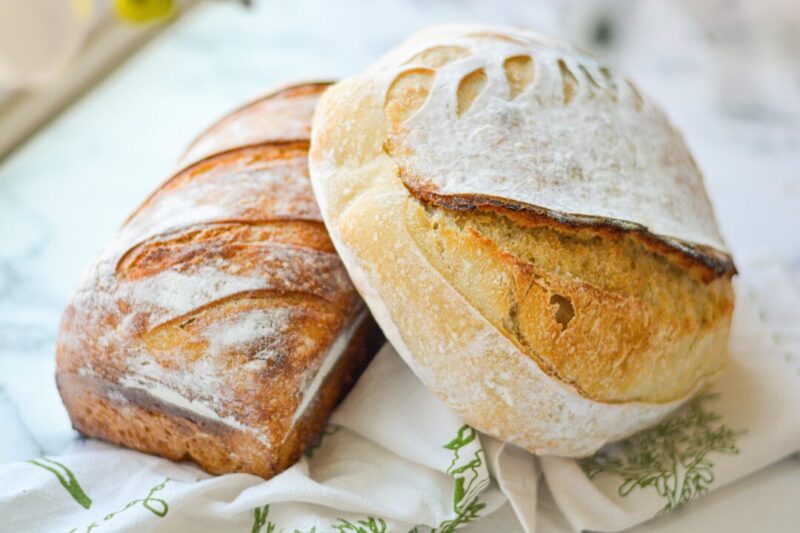


Easy Sourdough Bread Recipe

This sourdough bread is perfect for busy schedules. No folds needed! The result is amazing and you will only need few and simple ingredients.
ADJUST THE RECIPE/LOAF SIZE
Press 2x or 3x to bake more. For a different size, click the servings number above and type the amount you need. Every ingredient updates.
Equipment
- Large bowl
- Dough Scraper
- Loaf pan 9L x 5W x 3D (inches)
- Banneton 8 inches wide
- Scoring knife
- Parchment Paper
- Food plastic wrap
Ingredients
- 1000 grams All Purpose Flour
- 730 grams Water filtered, room temperature
- 20 grams Salt fine
- 200 grams Levain active sourdough starter
Instructions
Prepare the Active Sourdough Starter (Levain)
- Feed your sourdough starter 10-12 hours before planning to make this recipe.10 grams of mother sourdough starter100 grams of water100 grams of all purpose flourMix and let it sit in a warm spot (between 75-85°F) as you will need to use it once it has doubled in size.
Weigh all Ingredients
- Using your kitchen digital scale, weigh each ingredient separately
Mix the Dough
- Put all the ingredients in a large bowl and thoroughly mix using your hands. You want to mix the dough until you feel and see no dry spots.If you have a stand mixer, you can use the dough hook and mix for 3-5 minutes until you see no dry spots.
Bulk Fermentation
- Cover the dough using plastic wrap (or anything that will prevents the dough from creating a crust).
- Place the dough in a warm spot. Ideally 85°F.
- Then, set a timer for 4 hours.I highly recommend having a home dough proofer for this part of the process.If you can't find a spot within 80-85°F you will need to add 1 hour to the bulk fermentation process.Before you move onto the next step, you need to make sure that your dough has fully risen and has doubled in size.
Divide and Shape the Dough
- Flour the dough and using your fingers (or a round dough scraper) carefully go around the bowl to remove it. Flip onto your working table.You do not need to 'punch down' the dough.


- Divide the dough in half, as we are making 2 loaves.
- Fold the dough onto itself and roll up. Then shape into a ball by gently spinning it toward you. As the dough structure is weak, you will need to perform this movement 2 or 3 times. (Check the video for more detail)If using a banneton:Place the dough seem side-upIf using a loaf pan:Place the dough seam side-down
- Cover each dough with plastic wrap.
Asses fermentation
- After shaping, you need to check if the dough is filling up the banneton or loaf pan. You might have deflated it a little bit when shaping (or a lot if you are beginning). So, I highly recommend letting the dough sit in your warm spot so it rises more if needed.


Cold Fermentation
- Place the covered doughs in the fridge for 12 to 24 hours.
Preheat Oven & Score the Dough
- Preheat the oven to 450°F
- If using a banneton - put your dutch oven inside to preheat
- Once the oven is preheated, take the doughs out of the fridge and score.Check the video for more details.
Baking
- Bake for 20 minutes with lid on and then remove and bake for 20 additional minutes (uncovered).Keep in mind that all home ovens are different; you might have to make minimal adjustments to these temperatures or times.The internal temperature of the bread should be 210°F when fully baked.Remove the bread from the oven and place in a wire rack to cool.
Video
Notes
When making sourdough bread, one of the most important aspects is being able to control the temperature of the dough.
So, if you don't have a home proofer (links provided above), you will need to adjust the times for bulk fermentation. Giving the dough more time if your dough is colder than 85°F, and less time if the dough is warmer.
Remember to always focus on how the dough is looking, has it risen? how much approx? as these questions will keep you on the right track.
Have you made this one?Remember to tag me on IG @vituperiobread so I can see it!
