
Rosemary/Thyme and Cheddar Sourdough

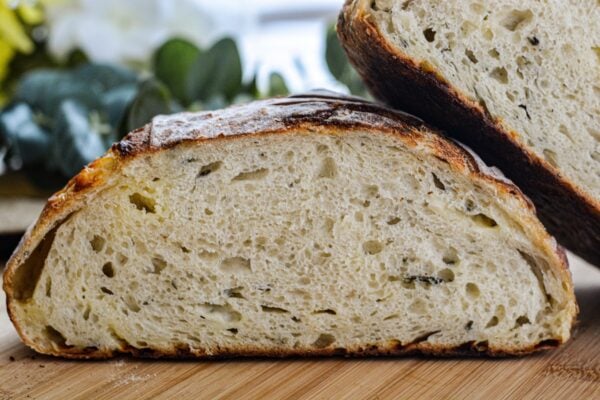
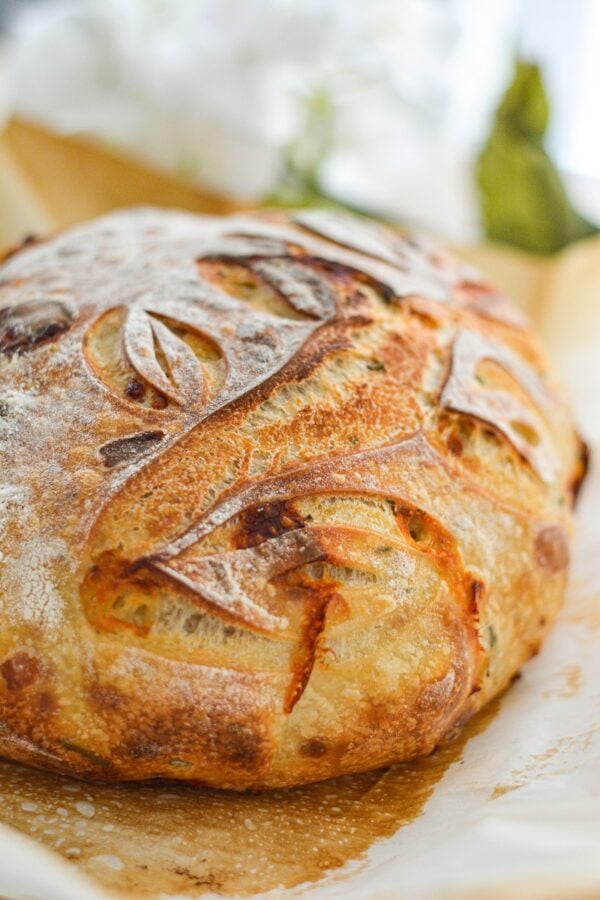
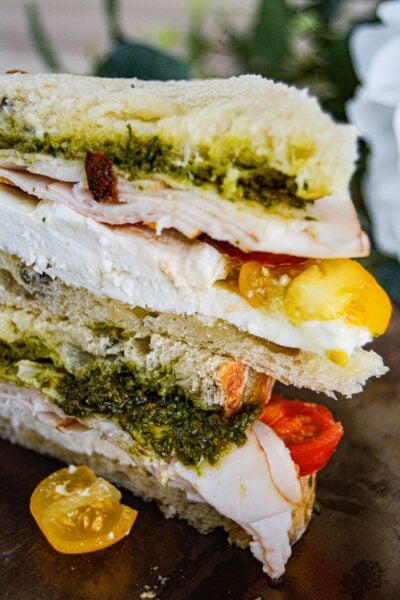
This Rosemary/Thyme and Cheddar Sourdough Bread, is perfect to have as an appetizer for lunch or as a sandwich bread for dinner. The soft texture given by the bread flour mixed with olive oil and the aromas that come out of it make any food better. I'm sure you will love it!
Equipment
- Digital Scale
- Bowl
- Scoring knife
- Banneton
- Dutch Oven
- Parchment Paper
Ingredients
- 500 Grams Bread flour
- 360 Grams Water room temperature
- 100 Grams Levain doubled in size
- 10 Grams Fine salt
- 15 Grams Extra virgin olive oil
- 2 Tablespoons Mix of rosemary and thyme
- 110 Grams Cheddar Cheese 4 ounces
Instructions
- Either 12 or 4 hours before you plan to mix the dough, feed your mother starter by following the instructions and ingredients provided above.You will need 100 grams for this recipe. The instructions for either schedule just make enough for 1 recipe.
- Once the levain is ready, using a digital scale, weigh each ingredient separately. Then, place everything except the cheddar, rosemary and thyme, inside your mixing bowl. You will add the fresh herbs and cheese later on in the process.


- Using your hand or your stand mixer (with the dough hook on medium speed) mix the ingredients until you see and feel no dry spots. Cover and let the dough rest for 30 minutes.
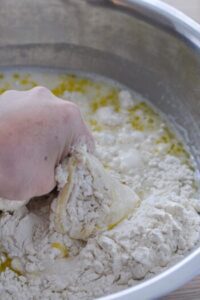

- After the above time has passed, thoroughly add the herbs and cheddar cheese. Mix until fully incorporated and you notice the additions are evenly distributed.
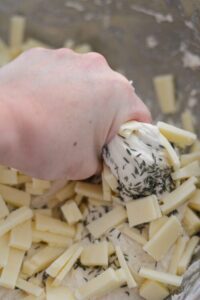
- Perform folds every 30-45 minutes for the next 3 to 4 hours (depending on the doughs temperature). During this part of the process you want the dough to rise. For that reason it is very important to keep the dough at around 85F. If you don't have a dough proofer and the temperature of the dough is lower, the time on this stage will increase.
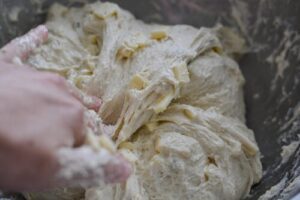
- Your dough by the end of the bulk fermentation (after you've performed all the folds) should look risen and feel very smooth, elastic and extensible. As the photo.
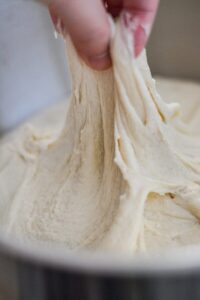
- Sprinkle flour on top, and using your hand or a scraper scoop the dough out of the bowl onto your kitchen counter.
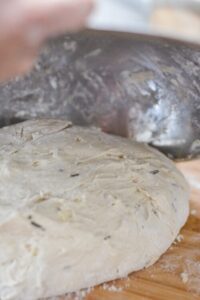
- Shape round or oval (depending on the shape of your banneton).

- Cover with plastic and let the dough rise until the rim of the banneton at room temperature. The banneton I used is 8 inches in diameter. If your banneton is wider, you won't allow it to rise that far up.
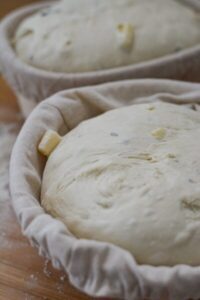
- After its risen, put the dough inside the refrigerator for 12 to 24 hours for cold fermentation.
- After the above time has passed, preheat your Dutch Oven at 475F.
- Once its preheated, bring the bread out of the refrigerator flip over parchment paper and score.
- Place the loaf inside the Dutch Oven with the parchment paper and bake for 20 minutes with the lid on.
- After the above time has passed, take the lid off and bake for an additional 10 to 15 minutes, depending on how dark or light you like the crust.
Video
Notes
Baking Temperature: 475F
Time: 30-40 minutes (half of the time with the lid on)
Have you made this one?Remember to tag me on IG @vituperiobread so I can see it!

If I choose not to do the starter, can I just use yeast and how much?
Hi Dennie! You can’t convert this recipe for one using commercial yeast, as it will completely change the ratios and also the process will need to be different. I will make something similar with commercial yeast and post it in the next weeks.
This recipe is great! I followed it exactly and ended up with a fluffy and flavorful loaf of bread. I definitely recommend this recipe to other bakers.
Hello! I loved using this rosemary/thyme with cheddar sourdough bread recipe but I can’t find it to use again…can you share it with me again?
Let me know how I can locate it or purchase this recipe.
Thanks, Sherree
Ugh I was so excited to try this.
I did the Levain quick rise (option 2) and used a scale and everything with the recipe and my loaf deflated ☹️ it smelled so good but I saw it start spreading as soon as I took it out of the fridge.
I’m guessing I underproofed or my starter wasn’t active enough.
My flat loaf is in the oven as we speak 😂 but smells great
Hi Annie, yes you probably overproofed it. It definitely still smells and tastes great. If you do it again please let me know how it turns out 🙂
This looks great. One question: Is the cheese amount (8 ounces) in weight or volume? I’m looking forward to trying this recipe soon. Thanks.
in weight!
You are welcome! and definitely the little changes make a difference 🙂
I did half the amount for one loaf and used aged double Gloucester and onion cheese and thyme it is superb
Done this 3 times now
Victoria I’m so glad to read that!! next time send me photos 🙂 would love to see!!
Hello!! I have attempted this recipe in total 3-4 times. I got success on my first 1st, it tasted and certainly smelled like HEAVEN <3. This prompted my 2nd attempt… a failure. and Now pictures of the 4th. I followed the recipe for two loaves however, the only change I made to prompt more leavening action, and eliminate any fears that my dough over-proofed the evening before, was to add 1g of the commercial premium red star platinum baking yeast (which definitely did the job). Here are pictures of the 4th bake and the two different scoring patterns I experimented with. I am not very good at that part yet. Enjoy! Thank you for the recipe Javi.
https://ibb.co/FV7xj2T
https://ibb.co/m0tV28S
https://ibb.co/cxGj14F
https://ibb.co/4tzmvTB
https://ibb.co/TWvpRf9
https://ibb.co/2gpLX8C
oh Patrick it looks amazing!! I’m so happy you have given it a couple of tries. If you ever have any additional questions just let me know 😉
Currently doing my stretch and folds but wanted to point out that there, I believe, is an error in your directions where you reference the ratios for feeding your starter. I believe it should be 100/100/100 and not 10/100/100. Please disregard if I am in error.
Is the ratio 10:100:100 correct???
I have used equal measures of starter, water, flour
It is, it will take around 12 hrs to rise (depending on the temp where its sitting at (if you prefer a different ratio, go ahead)
Before I try this recipe, I just wanted to know the correct ratio for the starter. whether 10:100:100 or 100:100:100. Thanks.
I’m relatively new to sourdough making. I made my own starter last Oct and stunned myself how perfectly it turned out (what a fun science experiment!)
I’ve been non-stop bread making ever since (& fell into the trap of having 4-6 jars of starters!)
I have experimented w/ a lot with different flavors, flours, etc, and came across this recipe as I wanted rosemarry & cheddar. I 1/2’d the recipe for 1 loaf….What I did: 1Tb dried rosemary, 1Tb dried thyme, 4 oz cheddar, 1 oz parmesean, 3 cloves garlic finely chopped, 350g bread flour, 100g wheat, 50g rye….dough puffed up nicely during the last proofing (and even more in the 16 hr fridge) It’s baking now & the house smells wonderully!
Diana, Im so happy to read your post! It is such a fun science experiment… and it will slowly become part of your life 🙂
This reciipe is wonderful! I cannot believe how springy and moist my bread turned out. I think much of it has to do with the olive oil, too. If any is left over I am going to make that into croutons for my turkey stuffing! What I would like to do is try to convert this type of recipe into a cranberry nut one. I am making a cranberry nut bread now and I think it should have had some oil in it. I won’t be baking it until I get back from my Bible Study, but I hope it turns out all right. I know how yours turned out so well and wish I could have done the cranberry one like this Rosemary and Thyme recipe. Although this bread is not a cold fermentation. I suppose that makes a difference? I need to find more recipes like yours.
Nanc
It would be helpful to have in the directions this was for two loaves. I always skip straight to the directions and I didn’t see two loaves anywhere until after I baked it and it didn’t turn out correct. Smells great and will probably still eat it but was a little disappointed.
Hi Diane, thanks so much for your feedback! I will definitely make the changes to makes sure that is more clear in the future. Javi